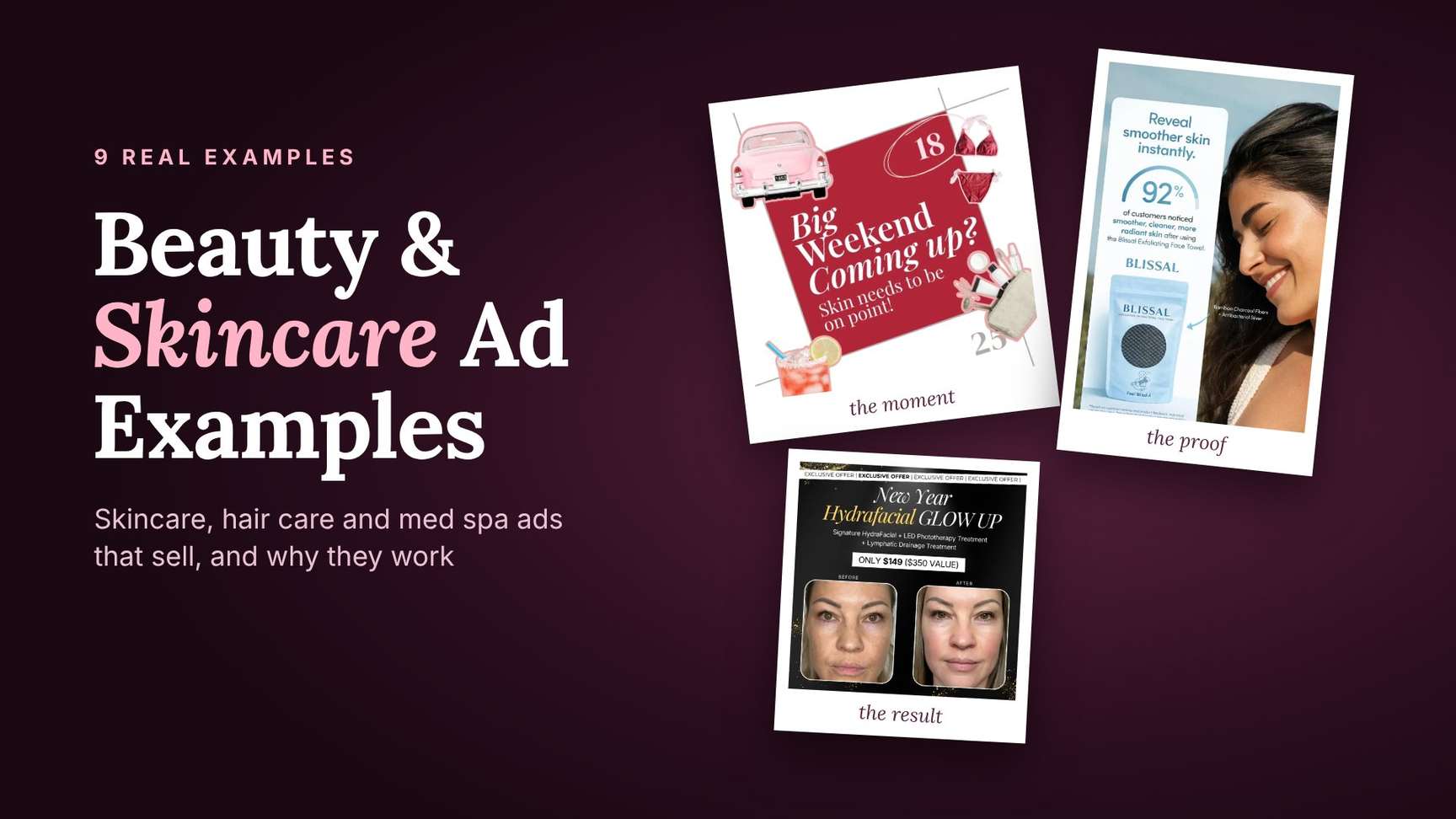
TL;DR: Beauty and skincare ads that sell do three things: they show a believable result, they speak to a moment in the buyer's life, and they make the offer clear. Below are 9 static beauty and skincare ads from my own portfolio, for skincare products, hair care and med spa treatments, with what each one does and what you can copy. At the end I cover Meta's rules for beauty ads and the mistakes that get them ignored or rejected.
Beauty is one of the hardest categories to advertise in. Everyone promises glowing skin. Everyone has a model with perfect lighting. Everyone says "clinically proven." The feed is full of ads that look the same.
The beauty ads that cut through usually do one of two things. They show something real (a real result, a real customer, a real number), or they tie the product to a real moment in the buyer's life, like a wedding, a holiday or a big weekend.
Below are nine static ads I designed for skincare brands, hair care and med spas. For each one I will tell you what it does, why it fits a beauty buyer, and what you can steal. I have not shared performance numbers, because results depend on the offer, the audience and the budget.
For more examples across other industries, see 12 static ad examples by industry. For Instagram-specific ideas, see Instagram ad examples.
What makes beauty and skincare ads different?
- The buyer is skeptical. They have bought products that did nothing. Proof matters more here than in almost any other category.
- The result is visual. Skin, hair and smiles can be shown, which makes before and after and close-up photos powerful, but also more closely watched by Meta.
- Emotion drives the purchase. People buy confidence, not just a cream. The best ads talk about how the buyer will feel.
- Timing matters. Events, seasons and holidays give beauty brands a natural reason to say "now."
Skincare ad examples
Example 1: The customer-number proof
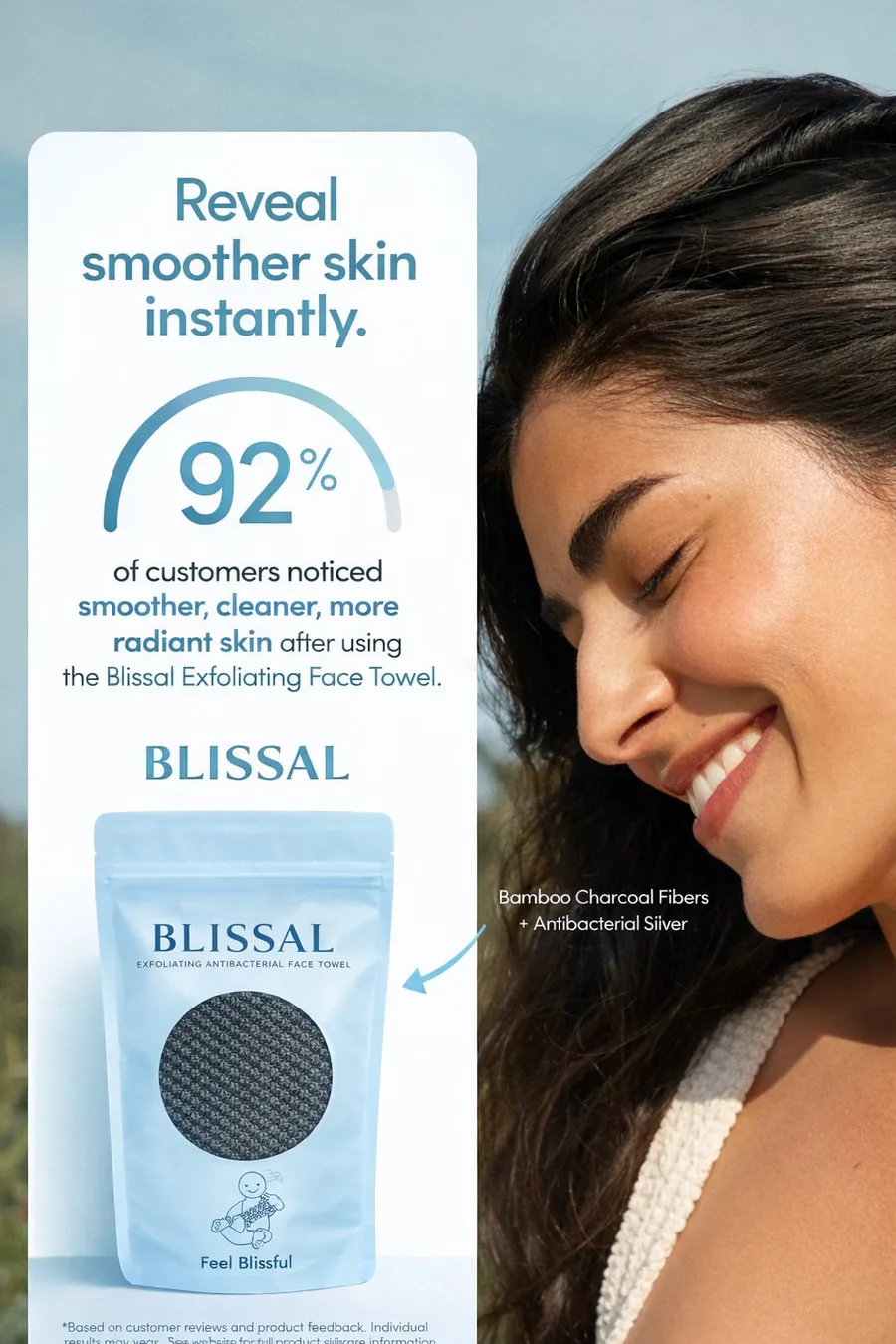
What it does: A tall panel on the left reads "Reveal smoother skin instantly." Under it, a big circle gauge shows "92%" with the line "of customers noticed smoother, cleaner, more radiant skin." The product pack sits at the bottom of the panel, and a smiling woman with clear skin fills the right side.
Why it works for beauty: A percentage of real customers is more believable than "the best towel ever." The gauge makes the number feel like data, not a slogan.
Steal this: Survey your customers and turn the answer into one big number. Add a small note on where the number comes from, as this ad does at the bottom.
Example 2: The offer-first ad
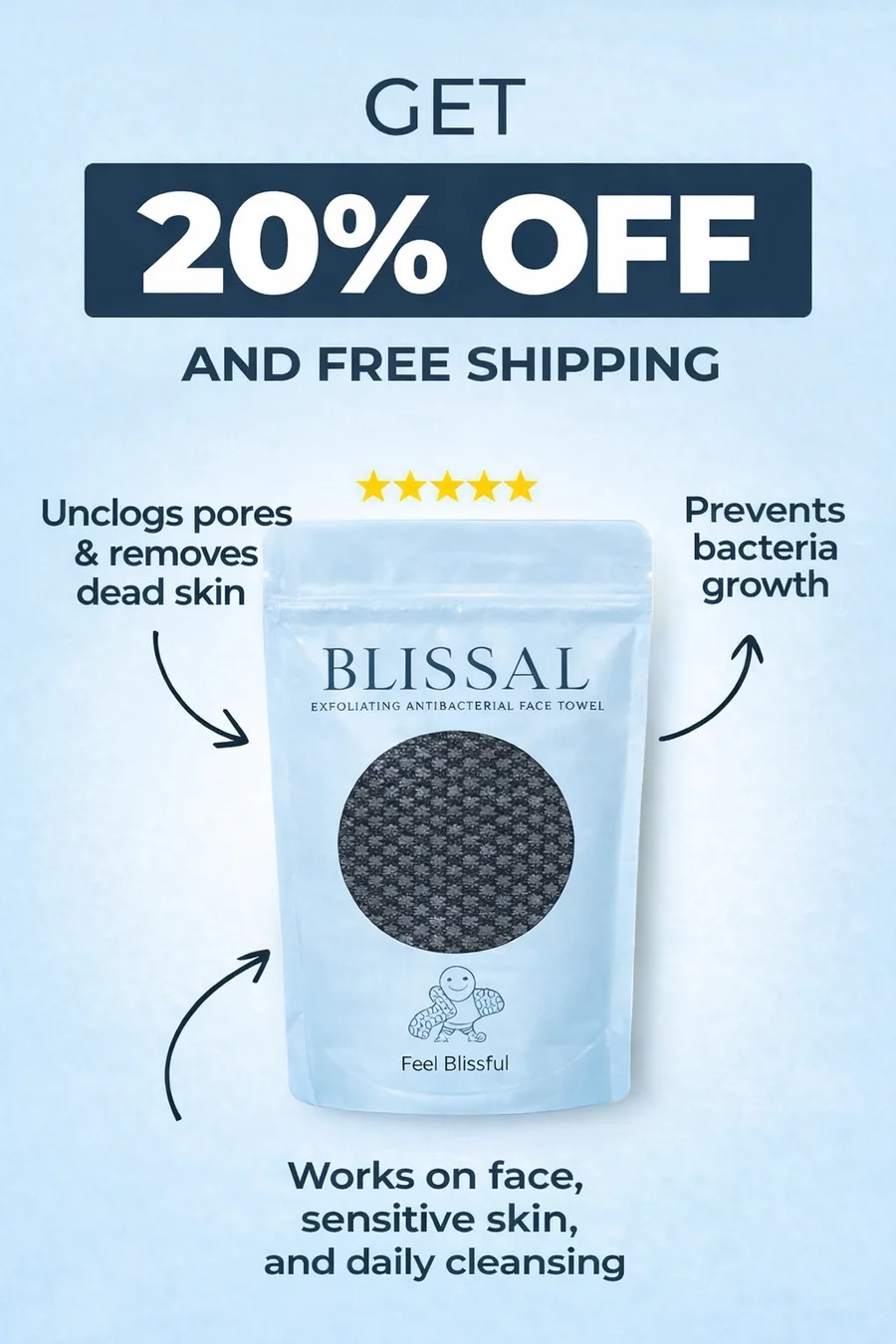
What it does: "Get 20% off and free shipping" takes the top third. The product pack sits in the middle with five stars above it, and three short labels around it: unclogs pores and removes dead skin, prevents bacteria growth, works on face, sensitive skin and daily cleansing.
Why it works for beauty: For people who already know the product, or who were retargeted after visiting the site, the deal is the reason to buy today.
Steal this: Use offer-first ads for warm audiences and retargeting. For cold audiences, lead with the problem or the result instead.
Example 3: The comparison
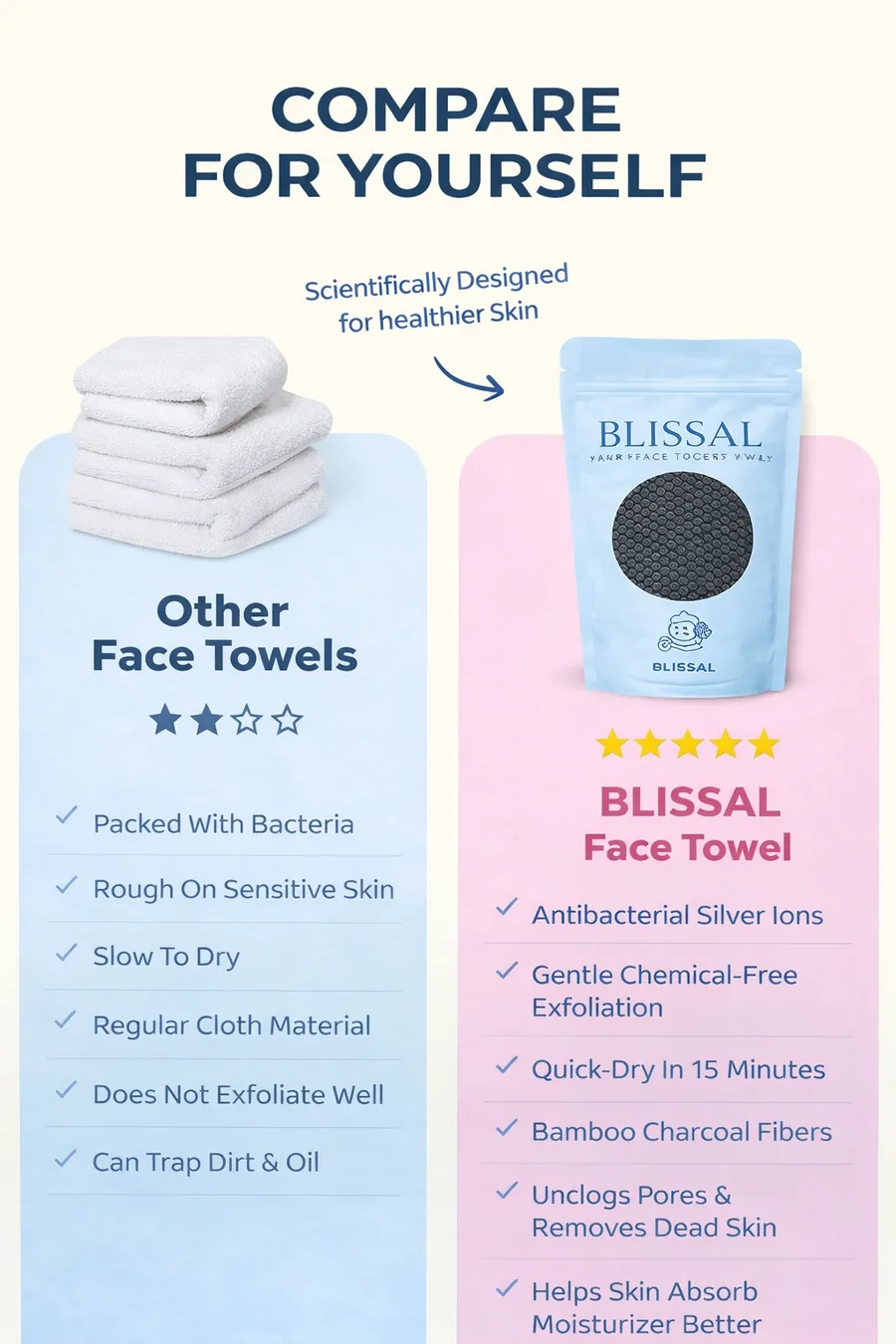
What it does: "Compare for yourself." Two columns: "other face towels" with two stars and weak points like "packed with bacteria" and "rough on sensitive skin," and the brand's towel with five stars and points like "antibacterial silver ions" and "quick-dry in 15 minutes."
Why it works for beauty: Skincare buyers love details. A side-by-side gives them the ingredient-level reasons they want, in a format they can scan.
Steal this: Compare against "regular" or "other" products, not a named brand. Grey for the other side, your brand color for yours. For more layouts like this, see Facebook ad templates.
Hair care ad examples
Example 4: The confident claim with a guarantee
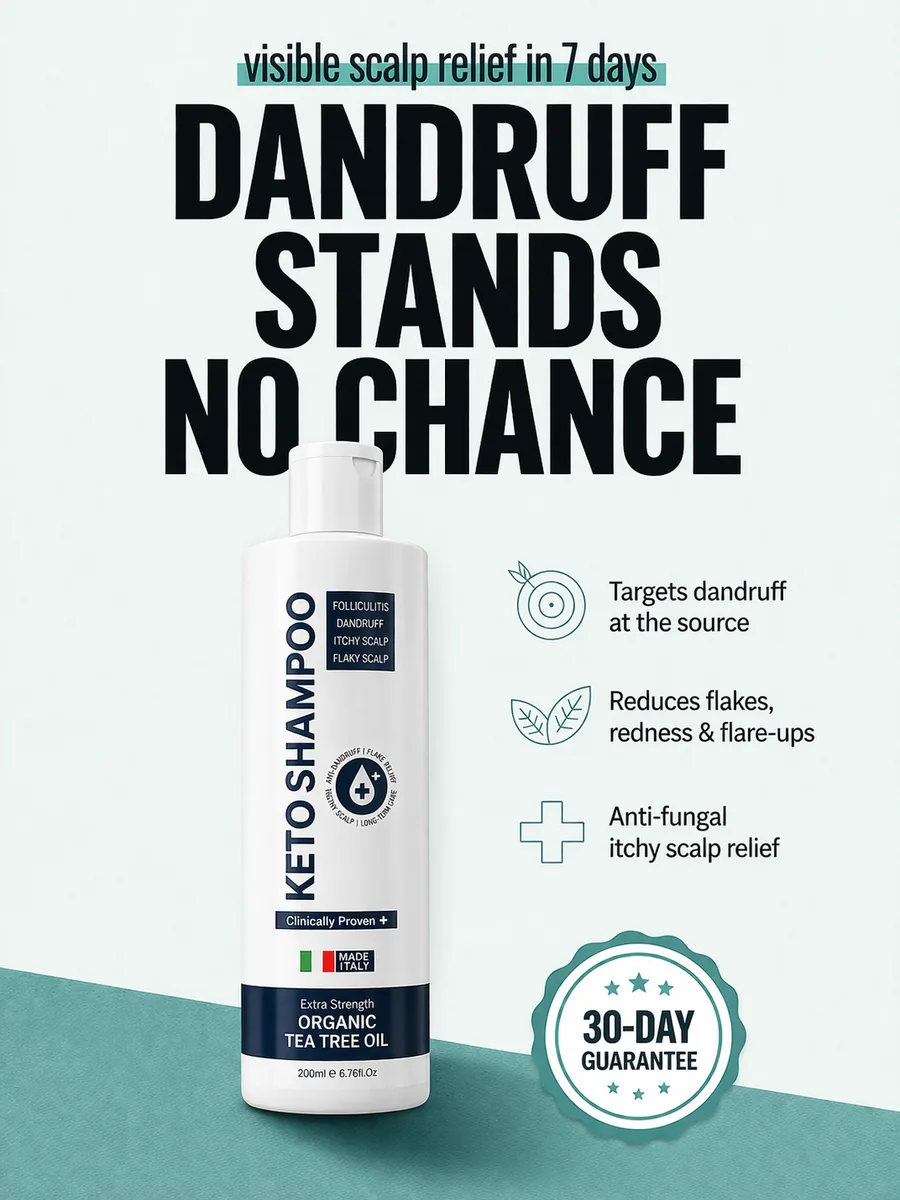
What it does: A small tag says "visible scalp relief in 7 days." The headline, in heavy black letters, says "Dandruff stands no chance." The bottle stands on the left, with three icon labels on the right (targets dandruff at the source, reduces flakes, anti-fungal itchy scalp relief) and a "30-day guarantee" badge in the corner.
Why it works for beauty: A bold claim on its own sounds like hype. A bold claim with a guarantee sounds like confidence. The guarantee lowers the risk of trying.
Steal this: If you offer a guarantee, put it on the image, not just on the website.
Example 5: The calm version of the same product
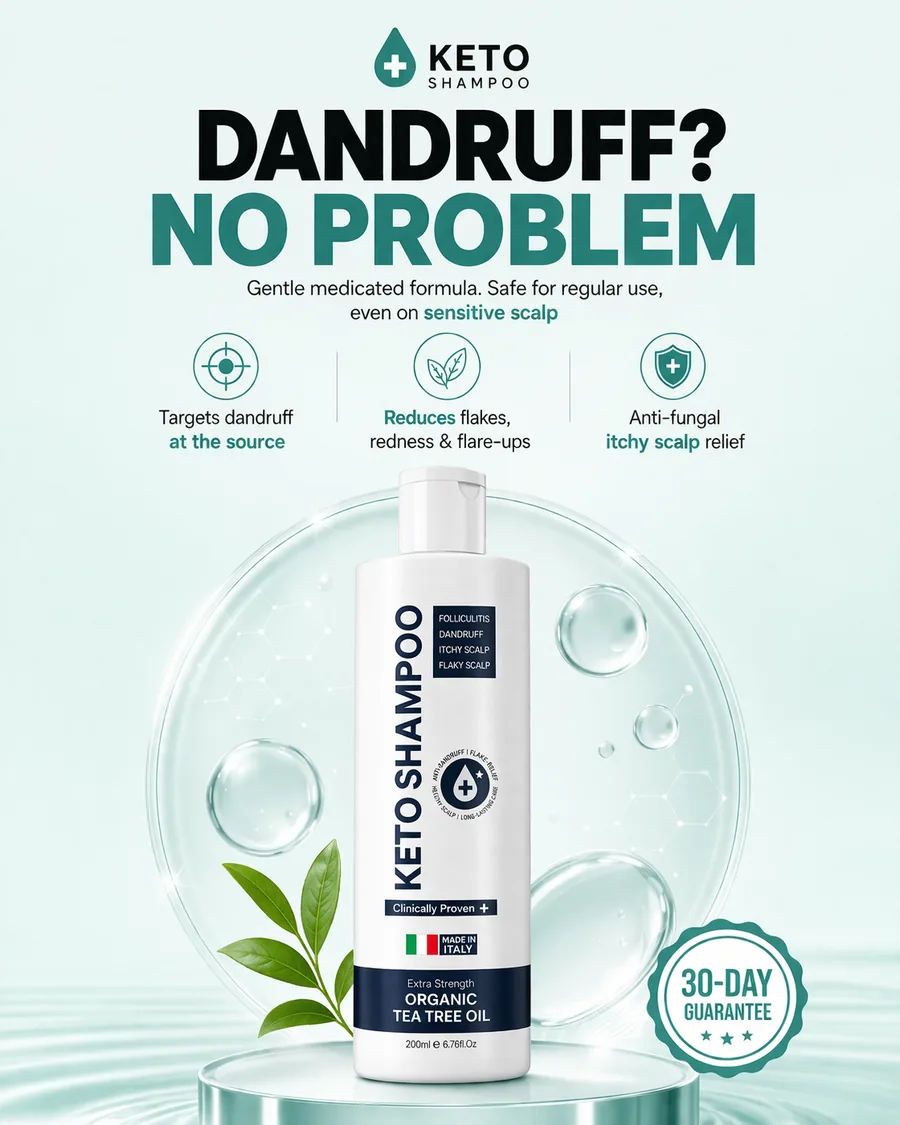
What it does: Same shampoo, different mood. "Dandruff? No problem." in a soft teal, with the bottle on a glass stand, water bubbles and leaves around it. A line says it is gentle enough for sensitive scalps.
Why it works for beauty: It is a different angle for a different buyer. Example 4 is for someone fed up with dandruff. This one is for someone worried that strong shampoos will irritate their scalp.
Steal this: Make two versions of the same product: one bold, one calm. Test which mood your buyers respond to.
Med spa and treatment ad examples
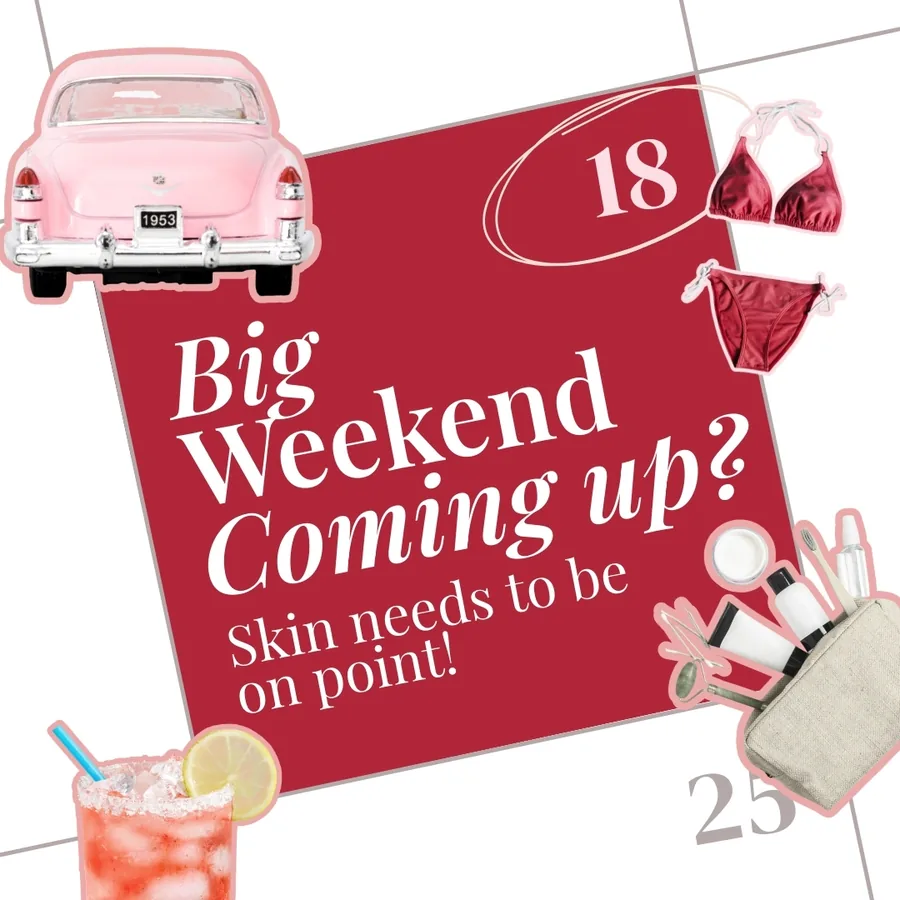
Example 6: The life-moment hook
What it does: A calendar page with a red square on one date. The headline, in a fun script: "Big weekend coming up? Skin needs to be on point!" Around it are small summer images: a pink vintage car, a bikini, a drink and a makeup bag.
Why it works for beauty: It does not sell a treatment. It sells being ready for a moment the buyer already has in their calendar. The ad creates a deadline without fake urgency.
Steal this: Tie your offer to an event your buyer cares about, like a wedding, a trip, a party or a photo day.
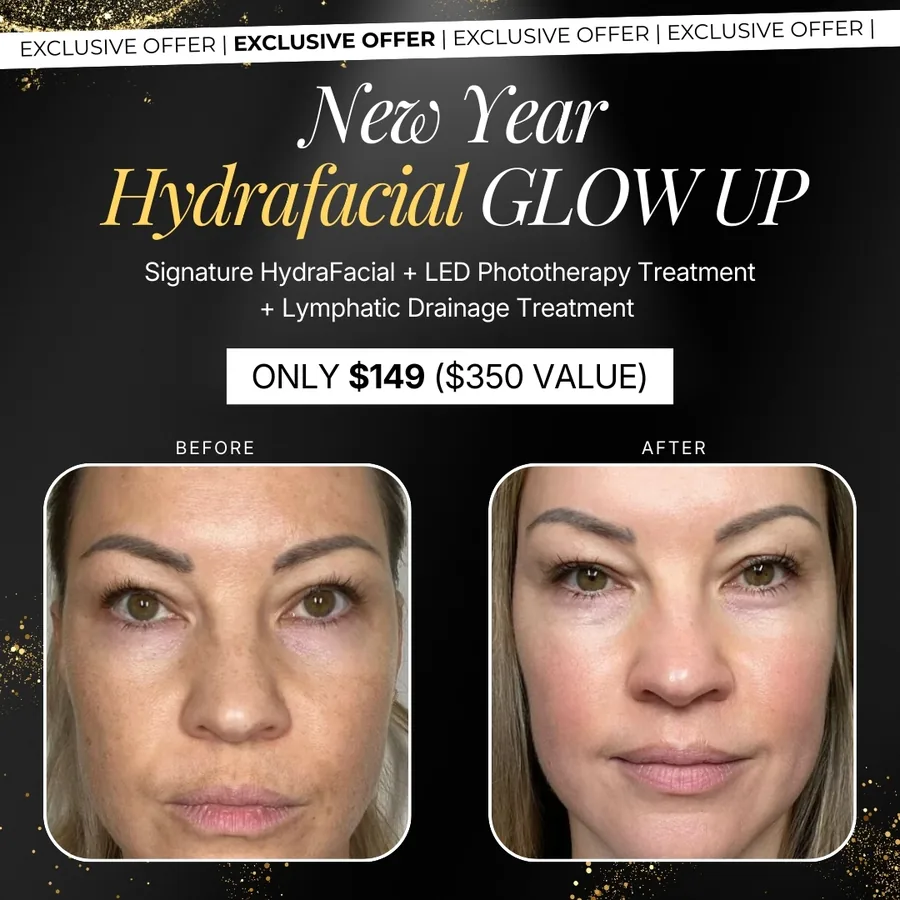
Example 7: The package with before and after
What it does: A black and gold ad with the headline "New Year Hydrafacial Glow Up." Under it, what is included (signature HydraFacial, LED phototherapy and lymphatic drainage), the price "$149 ($350 value)," and two clean before and after photos of the same face.
Why it works for beauty: It answers the three big questions at once: what do I get, what does it cost, and what will it do for me.
Steal this: Bundle treatments into a named package with a clear price. Use before and after photos from the same angle and lighting, with the client's permission.
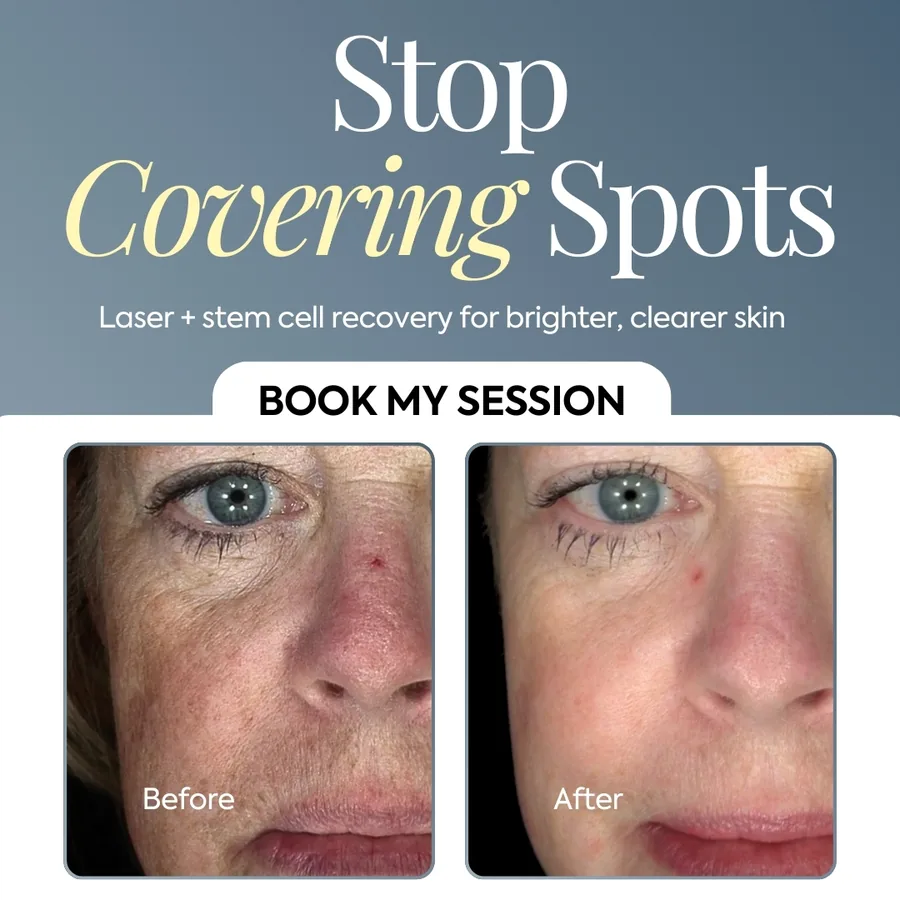
Example 8: The habit-based headline
What it does: "Stop covering spots" is the headline, with "covering" in an elegant script. A line under it explains the treatment, then a "Book my session" button sits on top of two close-up before and after photos.
Why it works for beauty: It names a daily habit the buyer has (covering spots with makeup) and offers a way to stop. That is more personal than "laser skin treatment."
Steal this: Find the daily habit your product replaces and put "stop" in front of it.
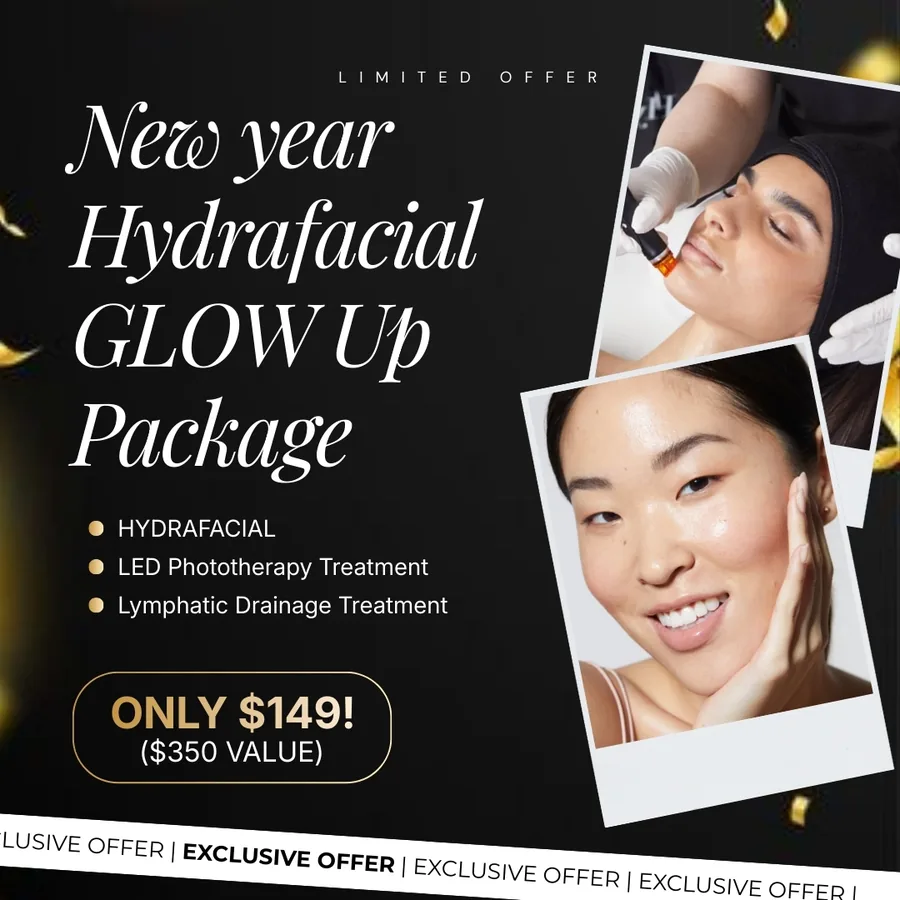
Example 9: The elegant offer
What it does: Large script lettering ("New year Hydrafacial Glow Up Package") on black with gold sparkles. A short list of what is included, a price badge ("Only $149! ($350 value)") and two photos of the treatment in progress, with an "exclusive offer" ribbon across the bottom.
Why it works for beauty: The style matches the buyer's expectation of a premium treatment. The photos show the experience, not just the result, which helps first-time clients picture themselves there.
Steal this: Show the experience (the room, the treatment, the care), not only the before and after.
The patterns behind these beauty ads
- Proof you can see. A customer percentage, a guarantee, a before and after, a comparison.
- A moment or a habit. A big weekend, the New Year, covering spots every morning.
- A clear offer. Price, value, what is included.
- One mood per ad. Bold or calm, fun or premium, never all at once.
- Two versions of the same product. Different angles for different buyers.
Meta's rules for beauty and skincare ads
I am not a lawyer, and Meta updates its policies often, so always check the current Meta Advertising Standards before you launch. Here are the main points beauty brands run into:
- No negative self-image. Meta's personal health and appearance policy says ads should not imply or try to create negative self-perception. "Hate your wrinkles?" is riskier than "Smoother skin in 2 weeks."
- Before and after needs care. Meta lists weight loss before and after images as non-compliant. Cosmetics are outside the scope of that policy, but treatments and procedures can face stricter review. Keep results realistic and do not edit the "after" photo.
- Avoid zoomed-in body shots that focus on a body part in a way that suggests something is wrong with it.
- Claims need proof. "Clinically proven" or "92% of customers" should be backed by a real study or survey you can show.
- Some products and procedures have age limits for targeting. Check the policy for your category.
If an ad gets rejected, it is often one word or one image. Change that piece and resubmit, rather than starting over.
Common beauty ad mistakes
- Using only polished model shots. Real customers and real results often beat perfect stock photos.
- Promising everything. "Glowing, firm, clear, young, hydrated skin" is five ads. Pick one.
- Hiding the price for treatments. If the price is good, show it. People skip ads that make them guess.
- Ignoring the season. Beauty buying spikes around holidays, weddings and summer. Plan ads around those moments.
- Letting one ad run forever. Beauty audiences tire of the same face fast. See how to fix creative fatigue.
Keep reading: if you sell supplements too, read supplement ads on Facebook for the claims you cannot make.
FAQ
What makes a good skincare ad?
A good skincare ad shows a believable result, gives one piece of proof (a customer number, a review, a guarantee or a before and after) and makes a clear offer. It focuses on one benefit instead of listing every possible one.
Can I use before and after photos in beauty ads on Facebook?
Often yes for cosmetics, but carefully. Meta does not allow before and after images for weight loss, and treatments can get stricter review. Use real, unedited photos with permission, keep results realistic and check Meta's current policy for your category.
What should a med spa ad include?
A named treatment or package, what is included, a clear price or offer, real photos of results or the experience, and one simple call to action like "Book my session." Tying the offer to a moment, such as an event or season, often helps.
Are static ads good for beauty brands?
Yes. Static ads let beauty brands test many angles quickly, such as offers, results, comparisons and moments, before spending on video. Many winning beauty video ads start as a winning static idea. See static vs video ads.
How many beauty ads should I test at once?
Start with three to five ads with clearly different angles, for example a result ad, an offer ad and a comparison. Keep the winner and make new versions of it. I give a plan by budget in how many ad creatives to test per week.
What words should beauty ads avoid?
Avoid words that suggest the buyer has a flaw ("ugly," "embarrassing," "fix your face") and claims you cannot prove ("guaranteed results," "cure"). Focus on the result and how it feels.
Need beauty ads that stand out?
I design static ads for beauty, skincare and med spa brands, plus other DTC, e-commerce and coaching brands. I do the strategy too, so you get angles and not only layouts. You can see what is included on my services page. If it looks like a fit, book a short call and we can start with a small test batch.